From holiday budget busters to calculating the cost of long-distance love, there were some great posts this week. Here are a few that caught my eye:
From AllFinancialMatters: Question of the Day - Holiday Budget Busters By just reading this post, I became a more mindful spender. Check out the various comments.
From Free Money Finance: Should You Get Paid Less to Telecommute? No! As a work-at-home writer, I actually work longer hours than I did when I was on a corporate payroll. This post includes very thoughtful comments.
From My Two Dollars: Make New Year’s Resolution To Get Organized - A Step By Step Guide. As an organizationally-challenged person, I operate on only two speeds: ADD or OCD.
This post offers a great guide.
From Mapgirl's Fiscal Challenge: Best Way to Use Up Medical FSA Funds A smart, smart list from one of my favorite bloggers. Hint: medical supplies & FSA Funds. Check her out!
From My Open Wallet: How Things Change: My Wacky Phone Spending This is a wonderful piece that links a money issue with personal reflections about a long-distance relationship. A great read!
From An English Major's Money: Just a Thought Boring job vs possible teaching career and subsidized-degree program. This post examines the fine points and options related to an unfulfilling job.
From Consumerist: 40 Million Americans Cannot Afford Needed Heath Care Says CDC [Health] I read this post with great interest.
______________
Digg!
The Frugal Duchess Booktique
The Frugal Duchess of Beauty Store
Book Shop of Fear
The Poetry & Drama Queen
Frugal Jazz & Blues
Frugal Comic Book Connection
__
Friday, December 07, 2007


Green & Frugal Holiday Tips from Natural Wildlife Federation
Use recycled holiday paper, DIY paper and LED lights. Those are a few of the green & frugal holiday tips & gift ideas from the Natural Wildlife Federation. Here's the list:
"Green Holiday Tips:
Christmas Trees and Lights Buy an organic, locally grown Christmas tree. Trees provide habitat for wildlife and absorb carbon dioxide while they are growing. A better idea is buy a living tree in a pot, plant it and enjoy it for years. New generations of affordable and stylish LED holiday lights are safe and use less energy than ever.
Save Paper Holiday cards and wrapping paper are two paper-heavy holiday traditions. Green your holiday this year by using cards and wrapping paper made out of recycled materials. Get the kids to make your own wrapping paper or cards. Have some fun and use recycled paper decorated with colorful holiday stamps, stickers or freehand designs for a personal touch.
Entertaining Make your holiday party earth-friendly by serving organic and locally produced foods. Visit local farmer's markets or natural grocery store for heritage breed turkeys, or really have an impact by going totally vegetarian for the holiday.
Holiday Decorating Buy an ornament and a portion of the cost goes to wildlife conservation or to plant a tree. That’s a simple way to “green” your tree. Don’t forget about the classics like popcorn, cranberries and ginger bread men to give your tree a nature friendly, homey and nostalgic look.
Nature Friendly Gift Ideas: (my disclaimer: some of these gift ideas are great, with obvious links to nwf.org's product line. Use your own judgment. Shop around or DIY, but the concepts are great.)
Bird Houses and Feeders: These inexpensive gifts add personality to any yard and give wildlife a place to call home. Or how about a “do-it-yourself” family project like homemade edible ornaments that will make your yard look festive and feed the birds at the same time?
Wild Birds Unlimited has a great product line and is an enthusiastic supporter of NWF’s Green Hour project.
Organic, Sustainable and Free Trade Products: From coffee and wine to wreaths and flowers, many programs deliver “green” and environmentally friendly products.
Green Mountain Coffee Roasters' National Wildlife Blend is a fair-trade organic coffee that helps protect migratory bird habitat by using shade grown coffee beans. Green Mountain Coffee Roasters offers coffee, sweet treats, gift baskets, brewer systems.
Frugal options: go to the Health food store or an organic farm and makde a DIY basket of organic products. Buy sale products or special promotions.
Organic Bouquet is the premiere floral resource for holiday wreaths. Organic Bouquet offers the finest floral gifts sourced from growers that are committed to the highest social and environmental standards. Each bouquet in the collection is hand selected and shipped fresh from the farm, ensuring optimal product quality upon delivery.
Carivintas Winery's Natures Wine Club collection celebrates the natural beauty and diversity of nature. Bottled from environmental-friendly vineyards.
Magazine Subscriptions for Kids Get the kids away from the video games with engaging magazines like NWF’s classic, award winning Ranger Rick . It’s fun and interactive just like Wild Animal Baby and Your Big Backyard for the younger kids.
Unplug the kids and get them connected to nature! ( http://www.rangerrick.org/ )
Adopt Wildlife or Wild Places From polar bears to sea turtles, symbolic adoptions offer gift givers and recipients the knowledge that the donations are being used to help protect imperiled wildlife and habitat across America. Check out the Adoption Center.
Experience Nature Technology can help you experience nature too. Take the new Identiflyer on a nature hike to identify the calls of 216 birds and frogs. For the less tech savvy, NWF field guides are a traditional way to connect with nature.
Recycled Products From fashions to tableware to yard art, there is new life from what was once headed to the land fill. Recycline’s Preserve line offers a host of green gifts for everyone on your list. The new Preserve Kitchen line includes: recycled plastic cutting boards, colanders, and food storage containers.
______________

The Frugal Duchess Booktique
The Frugal Duchess of Beauty Store
Book Shop of Fear
The Poetry & Drama Queen
Frugal Jazz & Blues
Frugal Comic Book Connection
__
"Green Holiday Tips:
Christmas Trees and Lights Buy an organic, locally grown Christmas tree. Trees provide habitat for wildlife and absorb carbon dioxide while they are growing. A better idea is buy a living tree in a pot, plant it and enjoy it for years. New generations of affordable and stylish LED holiday lights are safe and use less energy than ever.
Save Paper Holiday cards and wrapping paper are two paper-heavy holiday traditions. Green your holiday this year by using cards and wrapping paper made out of recycled materials. Get the kids to make your own wrapping paper or cards. Have some fun and use recycled paper decorated with colorful holiday stamps, stickers or freehand designs for a personal touch.
Entertaining Make your holiday party earth-friendly by serving organic and locally produced foods. Visit local farmer's markets or natural grocery store for heritage breed turkeys, or really have an impact by going totally vegetarian for the holiday.
Holiday Decorating Buy an ornament and a portion of the cost goes to wildlife conservation or to plant a tree. That’s a simple way to “green” your tree. Don’t forget about the classics like popcorn, cranberries and ginger bread men to give your tree a nature friendly, homey and nostalgic look.
Nature Friendly Gift Ideas: (my disclaimer: some of these gift ideas are great, with obvious links to nwf.org's product line. Use your own judgment. Shop around or DIY, but the concepts are great.)
Bird Houses and Feeders: These inexpensive gifts add personality to any yard and give wildlife a place to call home. Or how about a “do-it-yourself” family project like homemade edible ornaments that will make your yard look festive and feed the birds at the same time?
Wild Birds Unlimited has a great product line and is an enthusiastic supporter of NWF’s Green Hour project.
Organic, Sustainable and Free Trade Products: From coffee and wine to wreaths and flowers, many programs deliver “green” and environmentally friendly products.
Green Mountain Coffee Roasters' National Wildlife Blend is a fair-trade organic coffee that helps protect migratory bird habitat by using shade grown coffee beans. Green Mountain Coffee Roasters offers coffee, sweet treats, gift baskets, brewer systems.
Frugal options: go to the Health food store or an organic farm and makde a DIY basket of organic products. Buy sale products or special promotions.
Organic Bouquet is the premiere floral resource for holiday wreaths. Organic Bouquet offers the finest floral gifts sourced from growers that are committed to the highest social and environmental standards. Each bouquet in the collection is hand selected and shipped fresh from the farm, ensuring optimal product quality upon delivery.
Carivintas Winery's Natures Wine Club collection celebrates the natural beauty and diversity of nature. Bottled from environmental-friendly vineyards.
Magazine Subscriptions for Kids Get the kids away from the video games with engaging magazines like NWF’s classic, award winning Ranger Rick . It’s fun and interactive just like Wild Animal Baby and Your Big Backyard for the younger kids.
Unplug the kids and get them connected to nature! ( http://www.rangerrick.org/ )
Adopt Wildlife or Wild Places From polar bears to sea turtles, symbolic adoptions offer gift givers and recipients the knowledge that the donations are being used to help protect imperiled wildlife and habitat across America. Check out the Adoption Center.
Experience Nature Technology can help you experience nature too. Take the new Identiflyer on a nature hike to identify the calls of 216 birds and frogs. For the less tech savvy, NWF field guides are a traditional way to connect with nature.
Recycled Products From fashions to tableware to yard art, there is new life from what was once headed to the land fill. Recycline’s Preserve line offers a host of green gifts for everyone on your list. The new Preserve Kitchen line includes: recycled plastic cutting boards, colanders, and food storage containers.
______________
The Frugal Duchess Booktique
The Frugal Duchess of Beauty Store
Book Shop of Fear
The Poetry & Drama Queen
Frugal Jazz & Blues
Frugal Comic Book Connection
__
Thursday, December 06, 2007
$75,000 Robot & Top 10 Expensive Gifts w/Photos & Frugal Tips
One expert on self-made millionaires has issued his own list (with eye-popping photos) of the most extravagant holiday gifts and his advice: Forget the hype & shop within a real budget. It's a fun list with great visuals. (see below) I have one question: Who buys this stuff???

3. Runco 103-Inch Plasma Display- $99,995


5. Tiffany &Co. 109.73 Kunzite Bow Brooch - $74,500

6. Vertu 7.2 Carat Pink and White Diamond Phone - $73,000

7. Fendi Selleria Bag - $38,000
 8. 1-Degree North Pole Dogsled Expedition - $37,500

9. Serendipity Frrrozen Haute Chocolate - $25,000
 10. Friends of Cashmere Classic Pet Bed - $399

"Each year it seems that American’s top themselves in spending for Christmas,” says Trippon, “If you can afford the best without going into debt, that’s great! But I think most people forget that this holiday is about being in the right spirit, not getting overloaded with debt, which often produces money arguments the rest of the year.”
Trippon believes that people avoid arguing about finances when they take the time to become educated about money together.
“Get real and deal with your budget,” says Trippon, “Be honest with each other about your money habits and come up with a plan to spend it as a couple. It will improve your love life!”
Trippon is the author of the Amazon best-seller, How Millionaires Stay Rich Forever: Retirement planning Secrets of Millionaires and How They Can Work For You and the upcoming title China Stock Guru.
______________
Digg!
The Frugal Duchess Booktique
The Frugal Duchess of Beauty Store
Book Shop of Fear
The Poetry & Drama Queen
Frugal Jazz & Blues
Frugal Comic Book Connection
__
Here's the guest post with photos, prices and tips (after the photos):
"Americans are expected to dish out a staggering $474.5 billion this year on Christmas shopping, according to the National Retail Federation (NRF). Jim Trippon, CPA and one of America’s foremost authorities on the money habits of self-made millionaires, has released his annual list of the most expensive gifts to give your loved ones this holiday season.
“Here is Trippon’s annual top 10 list of the most expensive holiday gifts for 2007:
"Americans are expected to dish out a staggering $474.5 billion this year on Christmas shopping, according to the National Retail Federation (NRF). Jim Trippon, CPA and one of America’s foremost authorities on the money habits of self-made millionaires, has released his annual list of the most expensive gifts to give your loved ones this holiday season.
“Here is Trippon’s annual top 10 list of the most expensive holiday gifts for 2007:
1. Bugatti Veyron - $1.7 million

2. Neil Lane 15 Carat Diamond Earrings - $750,000
3. Runco 103-Inch Plasma Display- $99,995
4. Swami Conversational Robot - $75,000
5. Tiffany &Co. 109.73 Kunzite Bow Brooch - $74,500
6. Vertu 7.2 Carat Pink and White Diamond Phone - $73,000
7. Fendi Selleria Bag - $38,000
8. 1-Degree North Pole Dogsled Expedition - $37,500 9. Serendipity Frrrozen Haute Chocolate - $25,000
10. Friends of Cashmere Classic Pet Bed - $399Trippon's Advice:
"Each year it seems that American’s top themselves in spending for Christmas,” says Trippon, “If you can afford the best without going into debt, that’s great! But I think most people forget that this holiday is about being in the right spirit, not getting overloaded with debt, which often produces money arguments the rest of the year.”
The NRF said that Americans plan to spend an average of $923.36 in total this year, up 3.7 percent from the previous year’s statistics. Given the credit card rates that are often at 24 percent and assuming minimum payments, Trippon says that this year’s holiday shopping will cost the average consumer closer to $6458.87 when interest and finance charges are included.
Trippon believes that people avoid arguing about finances when they take the time to become educated about money together.
“Get real and deal with your budget,” says Trippon, “Be honest with each other about your money habits and come up with a plan to spend it as a couple. It will improve your love life!”
Trippon is the author of the Amazon best-seller, How Millionaires Stay Rich Forever: Retirement planning Secrets of Millionaires and How They Can Work For You and the upcoming title China Stock Guru.
______________
Digg!
The Frugal Duchess Booktique
The Frugal Duchess of Beauty Store
Book Shop of Fear
The Poetry & Drama Queen
Frugal Jazz & Blues
Frugal Comic Book Connection
__
This is Odd: Payday Loans Save Money?
Payday Loans! I've often thought of them as legalized loan-shark deals. Not so, according to this news release that cites a Federal Reserve study. The conclusion: Payday loans are helpful!?! Hmmmmm. Read this and comment. Here's the piece:
"Denying Consumers Access to Payday Loans Leads to Costlier Credit Options and Greater Financial Burdens
New staff research from the Federal Reserve Bank of New York details consumer hardships in North Carolina and Georgia after states eliminated the service
WASHINGTON, DC - Households without access to payday loans are forced to use costlier credit products and suffer greater financial difficulties, according to new research prepared by staff of the Federal Reserve Bank of New York.
Preliminary findings in the November 2007 working paper, "Payday Holiday: How Households Fare after Payday Credit Bans," by Donald P. Morgan and Michael R. Strain, Research Officers with the Federal Reserve Bank of New York, conclude that payday loan bans result in increased credit problems for consumers. The study compares households in states with payday loans with households in both Georgia and North Carolina, states which eliminated payday loans in May 2004 and December 2005 respectively.
They found, "Georgians and North Carolinians do not seem better off since their states outlawed payday credit: they have bounced more checks, complained more about lenders and debt collectors, and have filed for Chapter 7 ("not asset") bankruptcy at a higher rate." The authors note that, "This negative correlation-reduced payday credit supply, increased credit problems-contradicts the debt trap critique of payday lending, but is consistent with the hypothesis that payday credit is preferable to substitutes such as the bounced-check ‘protection' sold by credit unions and banks or loans from pawnshops."
The findings in the Federal Reserve Staff Report track closely with consumer responses given in a survey by the University of North Carolina Center for Community Capital, part of a recent study to determine how North Carolina consumers fared without the option of payday loans.
"While the UNC study concluded that consumers were better off without payday loans, this conclusion does not match the actual findings," said Darrin Andersen, president of the Community Financial Services Association of America (CFSA). "In fact, respondents' answers to the survey clearly show that the elimination of payday loans in North Carolina did nothing about the demand and forced consumers to replace payday loans with costly, less desirable and sometimes even dangerous options."
The survey found that consumers most frequently "did not pay/paid late" [an expense] when faced with a financial crisis. Other frequently cited strategies were "bounced checks/used overdrafts" or "used credit card/cash advance." Some admitted to having utilities disconnected, going without a prescription medication or ending up with a damaged credit rating. Andersen added, "In each case, consumers may have been better served by payday advances, which often offer lower fees and do not negatively impact credit ratings."
An independent analysis by Bretton Woods Inc. reported that, in 2006, North Carolinians paid an estimated $652 million to banks and credit unions in non-sufficient funds or over-draft protection fees. In fact, following three straight years of losing fee income, North Carolina's credit unions had their first increase once payday loans were no longer available in the state.
"There is a growing body of evidence by objective, independent researchers that validates what we have learned from our own customers," said Andersen. "Taken together, these studies demonstrate that people need access to short-term, low-denomination loans, and deprived of these, they are forced into other less desirable alternatives. This research demonstrates that state-regulated payday advances are an important credit option."
Highlights and links to the full studies are available at: Federal Reserve of New York Report, "Payday Holiday: How Households Fare after Payday Credit Bans
University of North Carolina Study
### About the Community Financial Services Association of America The Community Financial Services Association of America (CFSA) is the only national organization dedicated solely to promoting responsible regulation of the payday advance industry and consumer protections through CFSA's Best Practices. As such, we are committed to working with policymakers, consumer advocates and CFSA member companies to ensure that the payday advance is a safe and viable credit option for consumers."
______________
Digg!
The Frugal Duchess Booktique
The Frugal Duchess of Beauty Store
Book Shop of Fear
The Poetry & Drama Queen
Frugal Jazz & Blues
Frugal Comic Book Connection
__
"Denying Consumers Access to Payday Loans Leads to Costlier Credit Options and Greater Financial Burdens
New staff research from the Federal Reserve Bank of New York details consumer hardships in North Carolina and Georgia after states eliminated the service
WASHINGTON, DC - Households without access to payday loans are forced to use costlier credit products and suffer greater financial difficulties, according to new research prepared by staff of the Federal Reserve Bank of New York.
Preliminary findings in the November 2007 working paper, "Payday Holiday: How Households Fare after Payday Credit Bans," by Donald P. Morgan and Michael R. Strain, Research Officers with the Federal Reserve Bank of New York, conclude that payday loan bans result in increased credit problems for consumers. The study compares households in states with payday loans with households in both Georgia and North Carolina, states which eliminated payday loans in May 2004 and December 2005 respectively.
They found, "Georgians and North Carolinians do not seem better off since their states outlawed payday credit: they have bounced more checks, complained more about lenders and debt collectors, and have filed for Chapter 7 ("not asset") bankruptcy at a higher rate." The authors note that, "This negative correlation-reduced payday credit supply, increased credit problems-contradicts the debt trap critique of payday lending, but is consistent with the hypothesis that payday credit is preferable to substitutes such as the bounced-check ‘protection' sold by credit unions and banks or loans from pawnshops."
The findings in the Federal Reserve Staff Report track closely with consumer responses given in a survey by the University of North Carolina Center for Community Capital, part of a recent study to determine how North Carolina consumers fared without the option of payday loans.
"While the UNC study concluded that consumers were better off without payday loans, this conclusion does not match the actual findings," said Darrin Andersen, president of the Community Financial Services Association of America (CFSA). "In fact, respondents' answers to the survey clearly show that the elimination of payday loans in North Carolina did nothing about the demand and forced consumers to replace payday loans with costly, less desirable and sometimes even dangerous options."
The survey found that consumers most frequently "did not pay/paid late" [an expense] when faced with a financial crisis. Other frequently cited strategies were "bounced checks/used overdrafts" or "used credit card/cash advance." Some admitted to having utilities disconnected, going without a prescription medication or ending up with a damaged credit rating. Andersen added, "In each case, consumers may have been better served by payday advances, which often offer lower fees and do not negatively impact credit ratings."
An independent analysis by Bretton Woods Inc. reported that, in 2006, North Carolinians paid an estimated $652 million to banks and credit unions in non-sufficient funds or over-draft protection fees. In fact, following three straight years of losing fee income, North Carolina's credit unions had their first increase once payday loans were no longer available in the state.
"There is a growing body of evidence by objective, independent researchers that validates what we have learned from our own customers," said Andersen. "Taken together, these studies demonstrate that people need access to short-term, low-denomination loans, and deprived of these, they are forced into other less desirable alternatives. This research demonstrates that state-regulated payday advances are an important credit option."
Highlights and links to the full studies are available at: Federal Reserve of New York Report, "Payday Holiday: How Households Fare after Payday Credit Bans
University of North Carolina Study
### About the Community Financial Services Association of America The Community Financial Services Association of America (CFSA) is the only national organization dedicated solely to promoting responsible regulation of the payday advance industry and consumer protections through CFSA's Best Practices. As such, we are committed to working with policymakers, consumer advocates and CFSA member companies to ensure that the payday advance is a safe and viable credit option for consumers."
______________
Digg!
The Frugal Duchess Booktique
The Frugal Duchess of Beauty Store
Book Shop of Fear
The Poetry & Drama Queen
Frugal Jazz & Blues
Frugal Comic Book Connection
__
Sales 'R Us: Fine Tune Your Sales Pitch for a Better Life
We’re all pushing products. For example, a kindergarten teacher peddles Circle Time to five-year-olds. A community planner pitches a new system. We’re all in the sales business.
We’re all selling some service and product, including ourselves to bosses, students, teachers, co-workers and customers. Consider this: When we campaign for a new raise, we’re trying to sell our accomplishments to company management.
I'd like to think of myself as some kind of artist. But if I don't want to be a starving artist, I have to be real about the sales aspect of my job. As a writer, I’m constantly pitching stories to editors and readers. It’s a constant courtship and a push for attention, translating into dollars for me. Even when I send out poems to literary magazines, the manuscript -- with a pitch/cover letter -- has to be bundled in the right format, tone and technique.
Therefore, by learning more about sales techniques, I can improve my lifestyle and my income. That’s the message from Day 23 in the book Year To Success by Bo Bennett.
“Sales is an important, frequent and necessary part of life. The better we are at it, the more often we will get the things we want,” Bennett writes.
He defines sales "as the ability to gracefully persuade." Forget manipulation. In fact, if the image of a shady, used-car sales force represents your idea of the sales biz, think again.
Here are a few helpful links about selling:
Become a Better Salesperson
How to Be a Better Salesperson
______________
Digg!
The Frugal Duchess Booktique
The Frugal Duchess of Beauty Store
Book Shop of Fear
The Poetry & Drama Queen
Frugal Jazz & Blues
Frugal Comic Book Connection
__
We’re all selling some service and product, including ourselves to bosses, students, teachers, co-workers and customers. Consider this: When we campaign for a new raise, we’re trying to sell our accomplishments to company management.
I'd like to think of myself as some kind of artist. But if I don't want to be a starving artist, I have to be real about the sales aspect of my job. As a writer, I’m constantly pitching stories to editors and readers. It’s a constant courtship and a push for attention, translating into dollars for me. Even when I send out poems to literary magazines, the manuscript -- with a pitch/cover letter -- has to be bundled in the right format, tone and technique.
Therefore, by learning more about sales techniques, I can improve my lifestyle and my income. That’s the message from Day 23 in the book Year To Success by Bo Bennett.
“Sales is an important, frequent and necessary part of life. The better we are at it, the more often we will get the things we want,” Bennett writes.
He defines sales "as the ability to gracefully persuade." Forget manipulation. In fact, if the image of a shady, used-car sales force represents your idea of the sales biz, think again.
Here are a few helpful links about selling:
Become a Better Salesperson
How to Be a Better Salesperson
______________
Digg!
The Frugal Duchess Booktique
The Frugal Duchess of Beauty Store
Book Shop of Fear
The Poetry & Drama Queen
Frugal Jazz & Blues
Frugal Comic Book Connection
__
Wednesday, December 05, 2007
Good Karma & Lost Wallets: A Pay Back Story
During our recent travels, we found a wallet with cards, cash and other documents at a gas station. No problem. We looked around for the owner. He was not in the station or the convenience store.
Using an insurance card that was tucked into one of the compartments, we were able to track down the wallet's owner. (His insurance agent made the call and connection.) His father stopped by our home to pick up the wallet last week.
The wallet belonged to a young man and his father (late 50s-early 60s) told us this story:
When his son was a boy, the father and son were on a cruise ship from the Port of Miami, where the father worked. While hanging out with his dad, the boy found a wallet containing $600 in cash. The boy -- like any kid -- was excited about finding such treasure, but the father insisted that the boy return the wallet and all of the cash.
What's more, he didn't want his son to take a reward for finding the wallet stuffed with bills.
"One day, you'll lose your wallet and someone will return it to you," the father said.
Earlier this week, the father shared that story with me when he came to my home to pick up his son's wallet. He thanked us for returning the item and for paying back the good deed his son had done years ago. The scenario proved the father right. Good Karma, he said.
As we parted, he asked for the spelling of our names and he wanted to verify our zip code and apartment address. Today we received a gold Hallmark Thank You note in the mail from the son.
"Thank you for returning my wallet. This wallet is everything to me. Thank you so much for being honest......Happy Holidays! ---Michael R."
______________
The Frugal Duchess Booktique
The Frugal Duchess of Beauty Store
Book Shop of Fear
The Poetry & Drama Queen
Frugal Jazz & Blues
Frugal Comic Book Connection
__
Using an insurance card that was tucked into one of the compartments, we were able to track down the wallet's owner. (His insurance agent made the call and connection.) His father stopped by our home to pick up the wallet last week.
The wallet belonged to a young man and his father (late 50s-early 60s) told us this story:
When his son was a boy, the father and son were on a cruise ship from the Port of Miami, where the father worked. While hanging out with his dad, the boy found a wallet containing $600 in cash. The boy -- like any kid -- was excited about finding such treasure, but the father insisted that the boy return the wallet and all of the cash.
What's more, he didn't want his son to take a reward for finding the wallet stuffed with bills.
"One day, you'll lose your wallet and someone will return it to you," the father said.
Earlier this week, the father shared that story with me when he came to my home to pick up his son's wallet. He thanked us for returning the item and for paying back the good deed his son had done years ago. The scenario proved the father right. Good Karma, he said.
As we parted, he asked for the spelling of our names and he wanted to verify our zip code and apartment address. Today we received a gold Hallmark Thank You note in the mail from the son.
"Thank you for returning my wallet. This wallet is everything to me. Thank you so much for being honest......Happy Holidays! ---Michael R."
______________
The Frugal Duchess Booktique
The Frugal Duchess of Beauty Store
Book Shop of Fear
The Poetry & Drama Queen
Frugal Jazz & Blues
Frugal Comic Book Connection
__
Scaling Your Pay: How to Get More Money from Year-End Reviews
At one job, I received a coupon for a fat turkey as a year-end bonus. Another year, I received a 25 percent pay hike, plus a sweet one-time bonus. So, what's the deal for year-end reviews? And can you even push for a raise if you're in a minimum-wage job?
Yes, Yes, according to a few folks that I've recently chatted with, including Erin Burt, a contributing editor at Kiplinger's Personal Finance. Here's her advice about negotiating raises:
1. Use the clock well: Pick your battles wisely and keep an eye on the clock and the calendar. When are salaries, bonuses and performance reviews doled out? Did you just save the company a lot of money? Did you just score a major coup in customer service?
And if you work at a minimum wage job, consider this strategy: Did you pull in extra hours, while other people were off during the Thanksgiving? Did you work overtime when others declined?
Use those personal high-gloss moments to polish up your manager for a raise, Erin says: "Don't let them forget," she says. Ask for a raise during or right after a peak performance.
2. Know your value: Go to salary.com or make industry inquiries. Network! But find out how much your position is worth in the market. That advice comes from Mikelann R. Valterra, author of Why Women Earn Less .
3. Put yourself in your manager's shoes. Let's be real, Erin says. Your boss doesn't really care about your moving expenses, the new baby or your sister's wedding. "Only ask for a raise because you deserve it, not because you need it," she told me during our recent phone conversation. "You have to prove your value to your company."
4. Document your value. Both Erin and Mikelann recommend that you march into salary negotiations/job reviews/bonus requests with a brag list, either written or in your head. (I prefer written because when I get nervous my available memory crashes like an old school computer.) But have the facts ready to show how much you have done for the company. Maybe even rehearse your pitch.
5. Be Flexible: It's not all about the money and keep in mind that in a slow economy, the bonus pool may look like one of Pharaoh's skinny cows from the Biblical famine era. So if your manager has to skimp out on the money, consider asking for:
Bottom line, says Erin: Don't be shy about negotiating your salary or year-end bonus.
"That's all open for negotiations."
_____________
Digg!
The Frugal Duchess Booktique
The Frugal Duchess of Beauty Store
Book Shop of Fear
The Poetry & Drama Queen
Frugal Jazz & Blues
Frugal Comic Book Connection
__
Yes, Yes, according to a few folks that I've recently chatted with, including Erin Burt, a contributing editor at Kiplinger's Personal Finance. Here's her advice about negotiating raises:
1. Use the clock well: Pick your battles wisely and keep an eye on the clock and the calendar. When are salaries, bonuses and performance reviews doled out? Did you just save the company a lot of money? Did you just score a major coup in customer service?
And if you work at a minimum wage job, consider this strategy: Did you pull in extra hours, while other people were off during the Thanksgiving? Did you work overtime when others declined?
Use those personal high-gloss moments to polish up your manager for a raise, Erin says: "Don't let them forget," she says. Ask for a raise during or right after a peak performance.
2. Know your value: Go to salary.com or make industry inquiries. Network! But find out how much your position is worth in the market. That advice comes from Mikelann R. Valterra, author of Why Women Earn Less .
3. Put yourself in your manager's shoes. Let's be real, Erin says. Your boss doesn't really care about your moving expenses, the new baby or your sister's wedding. "Only ask for a raise because you deserve it, not because you need it," she told me during our recent phone conversation. "You have to prove your value to your company."
4. Document your value. Both Erin and Mikelann recommend that you march into salary negotiations/job reviews/bonus requests with a brag list, either written or in your head. (I prefer written because when I get nervous my available memory crashes like an old school computer.) But have the facts ready to show how much you have done for the company. Maybe even rehearse your pitch.
5. Be Flexible: It's not all about the money and keep in mind that in a slow economy, the bonus pool may look like one of Pharaoh's skinny cows from the Biblical famine era. So if your manager has to skimp out on the money, consider asking for:
- Flexible hours
- Telecommuting (maybe one day a week)
- Extra vacation days
- Stock options (They're so cheap)
- Tuition reimbursement
Even consider asking for a better title. "It looks good on your resume," Erin says. And maybe you can barter your enhanced title into a better job and more pay at another company.
Hey, once Erin received a book as a bonus. That's fine, because given a choice between a fat turkey and a book, I'd take the book any day as a bonus.Bottom line, says Erin: Don't be shy about negotiating your salary or year-end bonus.
"That's all open for negotiations."
Erin Burt, Contributing Editor for Kiplinger's, has written a great article called "Five Steps to Negotiating a Raise"
_____________
Digg!
The Frugal Duchess Booktique
The Frugal Duchess of Beauty Store
Book Shop of Fear
The Poetry & Drama Queen
Frugal Jazz & Blues
Frugal Comic Book Connection
__
Festive Frauds & Seasonal Scams: A Rundown of Holiday Crimes
From fake e-cards to bogus charitable pitches, there are many of seasonal scams. This list --from the Consumer Credit Counseling Service -- is excellent. The tip about getting anti-hacking firewall software info from Consumer Reports is also excellent. (see below) Feel free to chime in with scams that you have seen.
"Holiday scams are often delivered by bogus e-mails, direct mail or phone calls in order to gain access to personal financial and account information. Consumers can help safeguard their finances with the following tips:
Discard fake e-cards – These e-mails look like a holiday greeting from a family member, friend or well-known company, but these fake messages are simply "phishing" for information by posing as a legitimate communication and then querying the recipient for personal information, which can be used to access financial accounts.
Beware of charity pleas – Scammers capitalize on consumers’ generosity during the holiday season by sending out mass e-mails or placing professional-sounding telephone solicitations, disguised as well-known charities. Don’t be fooled into giving any personal information, such as making a gift via credit card that requires disclosure of card numbers, expiration dates and/or security codes. The best bet: initiate direct contact oneself to make a donation to a trusted charity.
Ensure retail Web sites are secure – When shopping online this holiday season, type in the Web site address rather than following links from an e-mail, which may lead to a bogus site built by a hacker trying to access personal information. Before providing a credit card or other account information to an online retailer, look for a small lock in the lower right-hand corner of the computer screen or an address that starts with https:// instead of http://.
Research before buying — When in doubt, investigate a retailer’s profile through the Better Business Bureau or other credible organization, and do not ever purchase anything from a company unless it has a physical address and phone number.
Watch for false credit card offers – Scammers often try to lure consumers into fake credit card applications – requiring the disclosure of personal data – when they think consumers need it most, such as the holiday buying season.
Seek product guarantees — Purchasing from reputable companies that provide written guarantees and/or warranties helps ensure more worry-free holiday shopping.
Keep good records — Always print receipts for items or services purchased online, including the price, date, time and purchase confirmation number, in case this information is needed later.
Install a firewall — Sensitive information like tax records, bank account information or credit card numbers are often available on one’s personal computer, and online hackers can be quick to access them if an Internet firewall is not installed on the computer.
Visit http://www.consumerreports.org/ for free guidance on firewall hardware and/or software options.
If needed, file a complaint – According to the Federal Trade Commission (FTC) Web site, consumers who suspect a business may have broken the law can file a complaint by calling the FTC toll-free at 1-877-FTC-HELP (1-877-382-4357) or file a complaint online at www.ftc.gov ."
Source: Consumer Credit Counseling Service
_____________
Digg!
The Frugal Duchess Booktique
The Frugal Duchess of Beauty Store
Book Shop of Fear
The Poetry & Drama Queen
Frugal Jazz & Blues
Frugal Comic Book Connection
__
"Holiday scams are often delivered by bogus e-mails, direct mail or phone calls in order to gain access to personal financial and account information. Consumers can help safeguard their finances with the following tips:
Discard fake e-cards – These e-mails look like a holiday greeting from a family member, friend or well-known company, but these fake messages are simply "phishing" for information by posing as a legitimate communication and then querying the recipient for personal information, which can be used to access financial accounts.
Beware of charity pleas – Scammers capitalize on consumers’ generosity during the holiday season by sending out mass e-mails or placing professional-sounding telephone solicitations, disguised as well-known charities. Don’t be fooled into giving any personal information, such as making a gift via credit card that requires disclosure of card numbers, expiration dates and/or security codes. The best bet: initiate direct contact oneself to make a donation to a trusted charity.
Ensure retail Web sites are secure – When shopping online this holiday season, type in the Web site address rather than following links from an e-mail, which may lead to a bogus site built by a hacker trying to access personal information. Before providing a credit card or other account information to an online retailer, look for a small lock in the lower right-hand corner of the computer screen or an address that starts with https:// instead of http://.
Research before buying — When in doubt, investigate a retailer’s profile through the Better Business Bureau or other credible organization, and do not ever purchase anything from a company unless it has a physical address and phone number.
Watch for false credit card offers – Scammers often try to lure consumers into fake credit card applications – requiring the disclosure of personal data – when they think consumers need it most, such as the holiday buying season.
Seek product guarantees — Purchasing from reputable companies that provide written guarantees and/or warranties helps ensure more worry-free holiday shopping.
Keep good records — Always print receipts for items or services purchased online, including the price, date, time and purchase confirmation number, in case this information is needed later.
Install a firewall — Sensitive information like tax records, bank account information or credit card numbers are often available on one’s personal computer, and online hackers can be quick to access them if an Internet firewall is not installed on the computer.
Visit http://www.consumerreports.org/ for free guidance on firewall hardware and/or software options.
If needed, file a complaint – According to the Federal Trade Commission (FTC) Web site, consumers who suspect a business may have broken the law can file a complaint by calling the FTC toll-free at 1-877-FTC-HELP (1-877-382-4357) or file a complaint online at www.ftc.gov ."
Source: Consumer Credit Counseling Service
_____________
Digg!
The Frugal Duchess Booktique
The Frugal Duchess of Beauty Store
Book Shop of Fear
The Poetry & Drama Queen
Frugal Jazz & Blues
Frugal Comic Book Connection
__
6 More Signs of Sloppy Money or Financial Daze
A Momma and the Boys Living on a Budget has an excellent post about sloppy money: My own list includes Windfall Retirement Fantasies.
Here's another list with signs of a financial daze or clueless money management.
1. Overstuffed wardrobe.Your closet is filled with new clothes with tags that you have forgotten about.
2. Unopened mail: You believe in the don't look/don't owe strategy of bill paying.
3. No-choice restaurant meals: You can't afford groceries so you charge restaurant meals on credit cards.
4. Minimum charge spending list: You shop on credit and buy more than you need or want because you don't have cash and have to buy enough to meet the minimum credit-card purchase amount.
5. Windfall Retirement Planning: You're not saving for retirement because you believe in found-money in the form of:1) a real estate sale or quick investment gains; 2) successful invention, deal or other sudden-rich move; 3) jackpot, successful lawsuit; 4) large cash gift from a relative or other one-time, special situation bonuses.
6. Unchecked credit score: It's bad, so why bother; why check? Why care?
I also wrote about signs of secret debt in this post.
______________
Digg!
The Frugal Duchess Booktique
The Frugal Duchess of Beauty Store
Book Shop of Fear
The Poetry & Drama Queen
Frugal Jazz & Blues
Frugal Comic Book Connection
__
Here's another list with signs of a financial daze or clueless money management.
1. Overstuffed wardrobe.Your closet is filled with new clothes with tags that you have forgotten about.
2. Unopened mail: You believe in the don't look/don't owe strategy of bill paying.
3. No-choice restaurant meals: You can't afford groceries so you charge restaurant meals on credit cards.
4. Minimum charge spending list: You shop on credit and buy more than you need or want because you don't have cash and have to buy enough to meet the minimum credit-card purchase amount.
5. Windfall Retirement Planning: You're not saving for retirement because you believe in found-money in the form of:1) a real estate sale or quick investment gains; 2) successful invention, deal or other sudden-rich move; 3) jackpot, successful lawsuit; 4) large cash gift from a relative or other one-time, special situation bonuses.
6. Unchecked credit score: It's bad, so why bother; why check? Why care?
I also wrote about signs of secret debt in this post.
______________
Digg!
The Frugal Duchess Booktique
The Frugal Duchess of Beauty Store
Book Shop of Fear
The Poetry & Drama Queen
Frugal Jazz & Blues
Frugal Comic Book Connection
__
Reader Asks: Why Am I Working For Minimum Wages?

In response to a post about secret debt, a reader called Minimum Wage asked:

Special Thanks to Mikelann R. Valterra for taking the time to chat with me.
I am a middle-aged white male with a liberal arts degree and a minimum wage job. I have no 401(k), IRA, or other investment accounts. Why do I earn less?
I offered a quick answer:
Here are a few reasons IMHO why some of us (including me) have earned less than we should: self-sabotage (been there, done that), wrong profession (ditto) and poor timing.
I ended with a promise to provide a longer, thoughtful response. Here is the followup.
During a conversation with Mikelann R. Valterra, (pictured below), author of Why Women Earn Less , we discussed reasons why men and women earn less. It's not a gender issue.
During a conversation with Mikelann R. Valterra, (pictured below), author of Why Women Earn Less , we discussed reasons why men and women earn less. It's not a gender issue.
Here's are her tips based on our phone interview: 

1. Study your work history. Is your low wage job a one-time event or an embedded part of your track history? If you're just stuck in a short-term rut because of a one-time special situation, don't worry. Everyone has low-lights in a career.
But if your resume is crowded with dead-end jobs, there is a bigger problem. "This is about a pattern," Mikelann said during our chat. "Why have you chosen to stay in a profession where you can't make money?"
2. Calculate your living costs: "Be clear about what you need to make," she said. "Once you are clear about that, you are totally in a different place." Be mindful about your money and spending. When we are unclear about how much we really spend and waste, we are usually unclear about the salary we need to earn.
3. Take inventory of your talents and skills. "Look at your skills and ask: is there something I can do to make the money I need?" For example, if your annual expenses/vacation plans, goals/savings targets require an annual salary of $50,000, put together a list of jobs or opportunities in that income bracket, Mikelann told me when we chatted by phone last night.
4. Read books on wages and underearnings. Beyond her own text, she recommends: Earn What You Deserve: How to Stop Underearning & Start Thriving (Mass Market Paperback) by Jerrold Mundis, a classic text written in 1995.

5. Be honest: We should ask ourselves these questions: Where have you undersold yourself? Do you ask for raises? Do you sabotage yourself during interviews or salary negotiations?
Special Thanks to Mikelann R. Valterra for taking the time to chat with me.
Tuesday, December 04, 2007
Forbes Ranks Young Celebs; MSN Charts Sliding Dollars: A News Roundup
MSN had an insightful package on the falling US dollar and Forbes provides a fun read about the young, rich & famous. Here are a few of the news stories that caught my eye today:
From Reuters: Fitness trumps fatness in longevity study
From New York Times: How Professional Is Your Doctor?
From Forbes: Forbes Lists the Richest Young Celebs
From Associated Press: Antibiotics don't help sinus infections
From MSN Money: More big trouble for the dollar
From MSNBC staff: Warming risks listed by population, costs (global warming cost estimates)
Digg!
The Frugal Duchess Booktique
The Frugal Duchess of Beauty Store
Book Shop of Fear
The Poetry & Drama Queen
Frugal Jazz & Blues
Frugal Comic Book Connection
__
From Reuters: Fitness trumps fatness in longevity study
From New York Times: How Professional Is Your Doctor?
From Forbes: Forbes Lists the Richest Young Celebs
From Associated Press: Antibiotics don't help sinus infections
From MSN Money: More big trouble for the dollar
From MSNBC staff: Warming risks listed by population, costs (global warming cost estimates)
And of my own stories today, I really enjoyed writing this post about small business errors:
Silly Goofs That Tank A Small Biz or Self-Employment
Digg!
The Frugal Duchess Booktique
The Frugal Duchess of Beauty Store
Book Shop of Fear
The Poetry & Drama Queen
Frugal Jazz & Blues
Frugal Comic Book Connection
__
Kiplinger Answers My Reader's Query: Bad Credit RX?
The folks at Kiplinger’s Personal Finance have provided an answer to a reader's recent question about credit-card repair, which followed a recent post on this site.
Here's the question:
In response to Kiplinger's formula for a healthy credit score, Anon wrote:
Kim Lankford, Contributing Editor, Kiplinger’s Personal Finance magazine provided this response:
Special Thanks to Kim Lankford for the prompt response.
Special Thanks to Laura Stevens from the The Rosen Group for making it happen so quickly and efficiently.
And, of course, kudos to Anonymous for asking the question.
______________
Digg!
The Frugal Duchess Booktique
The Frugal Duchess of Beauty Store
Book Shop of Fear
The Poetry & Drama Queen
Frugal Jazz & Blues
Frugal Comic Book Connection
__
Here's the question:
In response to Kiplinger's formula for a healthy credit score, Anon wrote:
That's very nice, but sometimes people get sick and can't work and lose their income and their credit goes in the tank. How do you get your credit out of the tank?
Kim Lankford, Contributing Editor, Kiplinger’s Personal Finance magazine provided this response:
"You can't erase a bad credit history, but you can take steps to improve your credit record from this point on. Negative items generally affect your score for up to seven years, but as time goes by their impact lessens.Here's a link to an article Kim wrote for the November issue profiling individuals who took control of their credit problems:
Continue using your cards, but clean up your act. Pay your bills on time, keep your account balances low, and be sparing in opening new accounts. As long you use credit conservatively, your score can rebound surprisingly quickly, says Craig Watts of Fair Isaac. We've seen cases of bankruptcy in which borrowers have qualified for a premium mortgage in three years.'"
Special Thanks to Kim Lankford for the prompt response.
Special Thanks to Laura Stevens from the The Rosen Group for making it happen so quickly and efficiently.
And, of course, kudos to Anonymous for asking the question.
______________
Digg!
The Frugal Duchess Booktique
The Frugal Duchess of Beauty Store
Book Shop of Fear
The Poetry & Drama Queen
Frugal Jazz & Blues
Frugal Comic Book Connection
__
I Save Money with Tea Tree Oil: Anti-Lice, Anti-Acne Cures!

Tea Tree Oil is the wonder product in my house. It's natural. It's effective. It's cheap. We purchase small bottles of this essential oil at the health food store and a little drop goes a long way.
Of course, with this post, I am stepping into the land of TMI (too much information), but I'm offering a small glance into my personal biz to show how Tea Tree Oil really works, with some expert testimony from a few health care and beauty books.
1. Blemishes: I am almost 50, but I feel like I'm a teenager at times. The good news: In humid South Florida, the weather creates a natural anti-wrinkle shine on my skin. The bad news: Hello Zits! Fortunately, Tea Tree Oil --applied very sparingly with a Qtip -- zaps the zits. Test first to make sure that you can take the sting or dilute with a bit of olive oil.
2. Athlete's Foot: Someone in my family developed athlete's foot. But a bit of Tea Tree Oil (on a Qtip) halted the problem quickly and effectively.
3. Head lice: OMG! This is a biggie! A few years, ago when my kids were in pre-school and elementary school, head lice went through the classrooms. Horrors! And for a family of kinky, curly and wavy hair, the lice incident was a nightmare. Awful, awful. It's another warm weather hazard. Unfortunately, the commercially prepared head lice medicines scared me. The warnings and possible side effects were worse than the lice.
And later, I felt justified. After our head lice episode, a close, close friend told me that her sister developed seizures after exposure to professional anti-lice medicine.
A natural solution: Tea Tree Oil mixed with olive oil, mayonnaise and other essential oils. I know that it sounds sooo yucky. But if you leave that formula in all day or all night on a covered head (use a shower cap), the lice are smothered.*
Bottom line: Even if you use one of the professional chemical formulas, you still have to pick out all of those darn lit nits anyway. That's the source of the term nit-picking.
4. Dandruff/head treatments/scalp massages: Tea Tree Oil is amazing as a scalp treatment. I don't understand why consumers spend a fortune for expensive beauty products that include Tea Tree Oil. I saw one expensive product for $16-20. Why not just add a few drops of the natural concentrate to one of the frugal ($1-2) no-name conditioners or shampoos in the drugstore?
I'm not nuts or odd: Various formulas using Tea Tree Oil can be found in the Ageless Natural Beauty book by Sally Freeman. I love this book and refer to it frequently. The book has formulas for using Tea Tree Oil in deodorants, hair care, pedicures and skin care. I recently spotted the book on eBay for $2.99
Likewise, Nature's Pharmacy by Dr. Lynne Paige Walker and Ellen Hodgson Brown offers a great overview of the various medicinal and cosmetic uses for Tea Tree Oil:
"This remedy has a wealth of uses. It can be used as an anti fungal for athlete's foot, fungus in the mouth, fingernail or toe-nail fungus, a scalp cleanser for problems such as dandruff and lice; a gargle for sinus congestion, sore throat and sore gums; a topical remedy for canker sores, cold sores, acne, minor cuts, abrasions, insect bites, rashes, after shaving or waxing or minor burns."-Nature's Pharmacy(Note: Tea Tree Oil and other essential oils should be used and handled carefully. Please follow package warnings and directions.)
I spotted the Nature's Pharmacy on Amazon for $5.29. I have a deal with Amazon, but I'm not making money for plugging/selling either of these books. I think I found the Beauty book at a remainder's table for $5 at Barnes & Nobles. And I'm not sure where we found the second book: maybe at a yard sale or used book store. I hope it's not a borrowed book that I forgot to return to a friend.
*Disclaimer: I'm not a health or beauty expert. I'm just a crazy tester, willing to experiment with my hair and skin. My solutions work for me. These tips might not work for you or your family.______________
Digg!
The Frugal Duchess Booktique
The Frugal Duchess of Beauty Store
Book Shop of Fear
The Poetry & Drama Queen
Frugal Jazz & Blues
Frugal Comic Book Connection
__
Silly Goofs That Tank A Small Biz or Self-Employment
 Good work habits are not enough if you are self-employed or own a small business, according to Ruth King, president and CEO of ProfitabilityChannel.com. A lot of us --myself included--work harder, but not smarter, according to King.
 She was profiled in a July 1, 2007 issue of Bottom Line Personal. The issue was in a stack of newsletters (excellent!) that my mother gave to me. Here are "dumb mistakes" that can kill our best efforts.
1. Over-relying on a single customer. In my bag lady post, I wrote about this topic. Basically, one small publication paid me well and represented about 80 percent of my freelance income. When they added a staff position, my freelance work flow (and income) suffered.
Likewise, King says that small operations can fail when a single customer represents 50 to 100 percent of income. Your client -- like mine -- can shift "a previously outsourced function in-house," or cancel a product line or contract, King said in Bottom Line Personal Finance. They can also just fire you. Anything can and will happen.
King--who wrote The Ugly Truth About Small Business: 50 Never-saw-it-coming Things that Can Go Wrong...And What You Can Do About It - urges a small biz to not let a single customer represent over 25 percent of revenue.
2. Letting key employees go to competitors. Important workers can walk out the door with key contacts and knowledge. Solution: keep 'em happy with pay, perks and praise, King says.
3. Not minding the books: Small companies sometimes place too much faith in their bookkeeper. I've heard of small companies that have been hit by embezzlers who were either trusted employees or so-called friends.
Their experiences remind me of the Billy Holiday song: God Bless The Child (who's got his own). checkout this video clip of God Bless the Child as sung by LaKisha Jones on American Idol. (wonderful!)
Bottom Line: Watch your own back, study your books and create some form of financial oversight.
"Do not give a bookkeeper check signing privileges," King says. She also recommends that you direct your bank to send financial statements to your home.
4. Naively pushing a hobby into a workplace: Been-there-done-that. This is a big problem for many entrepreneurs. This topic deserves its own post and I will circle back on this subject later. But here's a quick summary: Do your homework before you turn a craft or passion into a full-time business.
5. Maintaining ties with just one bank: King says that there is safety in financial numbers. Diversify your portfolio of banks with relationships with at least two institutions.
6. No sick- day plans. Again this topic is worthy of its own post and I will post a piece just on this subject. But here's the quick sketch: Sick days, illnesses and accidents happen. If you work for yourself, you need a plan to cover work stoppages.
7. Failing to delegate. Mind the store, but don't be a total control freak. You will make yourself crazy if you try to do everything all the time.
8. Poor or unreliable contractors or suppliers: A friend of mine once suffered a major business setback when he worked with a pair of unreliable sub-contractors. Their failure to show up for work on time or to deliver quality work reflected poorly on him and cost him money.
source: July 1, 2007 issue of Bottom Line Personal
Ruth King, president and CEO of ProfitabilityChannel.com.
other recommended resources: http://www.startupnation.com/ or http://www.smallbusinessadvocate.com/
Monday, December 03, 2007
Sean Taylor, Brad Pitt & Other News: A Round-Up
From Brad Pitt's green buildings to a cheap & sweet cold cure, here are a few of the news stories that caught my eye today.
News & Sports
Thousands attend funeral for Redskins star Taylor: A very tragic story for Miami, the NFL and and the family of football star Sean Taylor. In addition to a story about crime, greed and violence, there's another sad tale about the dangers of rushing to judgment. The initial reports about Taylor's murder were very biased and seemed to place the blame on the victim. Many news accounts stressed Taylor's past problems and seemed to link his past woes with his murder. However, he was a victim of a break-in.
Dan Le Batard of the Miami Herald wrote a thoughtful piece about the media and the biased early reports about Taylor's murder. Media Failed with Taylor Coverage.
Can Climate Change Without US Involvement?: The long-term costs of global warming are staggering.
Twin Falls Times-NewsDespite blown chances, Eagles still thinking playoffs My parents are Phila. Eagles fans. I listen to the Miami Dolphins on the radio. OMG! They are 0-12: Falling flat again
Honey works best to calm kids' coughs, study finds This frugal, low-risk option also works in my house. Peppermint tea with (lots of lemon and honey) is also soothing. Besides, some of the cough medicines are expensive for parents and dangerous for kids.
Peanut Allergies Showing Up At Much Earlier Ages
Entertainment News:
Two example of how money and fame can be used for good works.
Brad Pitt building green homes in New Orleans:
Leno To Pay Laid-Off Staff -
- ______________
Digg! src="http://digg.com/img/badges/85x10-digg-link.gif" width=85>
The Frugal Duchess Booktique
The Frugal Duchess of Beauty Store
Book Shop of Fear
The Poetry & Drama Queen
Frugal Jazz & Blues
Frugal Comic Book Connection
__
News & Sports
Thousands attend funeral for Redskins star Taylor: A very tragic story for Miami, the NFL and and the family of football star Sean Taylor. In addition to a story about crime, greed and violence, there's another sad tale about the dangers of rushing to judgment. The initial reports about Taylor's murder were very biased and seemed to place the blame on the victim. Many news accounts stressed Taylor's past problems and seemed to link his past woes with his murder. However, he was a victim of a break-in.
Dan Le Batard of the Miami Herald wrote a thoughtful piece about the media and the biased early reports about Taylor's murder. Media Failed with Taylor Coverage.
Can Climate Change Without US Involvement?: The long-term costs of global warming are staggering.
Twin Falls Times-NewsDespite blown chances, Eagles still thinking playoffs My parents are Phila. Eagles fans. I listen to the Miami Dolphins on the radio. OMG! They are 0-12: Falling flat again
Honey works best to calm kids' coughs, study finds This frugal, low-risk option also works in my house. Peppermint tea with (lots of lemon and honey) is also soothing. Besides, some of the cough medicines are expensive for parents and dangerous for kids.
Peanut Allergies Showing Up At Much Earlier Ages
Entertainment News:
Two example of how money and fame can be used for good works.
Brad Pitt building green homes in New Orleans:
Leno To Pay Laid-Off Staff -
- ______________
Digg! src="http://digg.com/img/badges/85x10-digg-link.gif" width=85>
The Frugal Duchess Booktique
The Frugal Duchess of Beauty Store
Book Shop of Fear
The Poetry & Drama Queen
Frugal Jazz & Blues
Frugal Comic Book Connection
__
Kiplinger's Three Rules for Great Credit Scores
This guest post is from Kiplinger's:
"The December issue of Kiplinger’s Personal Finance offers three simple rules to improve your score:
1. Pay bills on time. Your payment history makes up more than one-third of your score.
2. Keep the balance on your credit cards below 25% of your available credit. In FICO’s model, your actual credit limit isn’t as important as your credit utilization ratio—the percentage of your limit that you’ve actually used.
3. Limit applications for new credit. Each time you apply for new credit—especially if you have a short credit history or few accounts—an inquiry is made on your credit report. Inquiries themselves are tiny dings—but a lot of dings can add up to a big dent.
The article in its entirety is available at http://www.kiplinger.com/magazine/archives/2007/12/perfect-credit-score.html."
______________
The Frugal Duchess Booktique
The Frugal Duchess of Beauty Store
Book Shop of Fear
The Poetry & Drama Queen
Frugal Jazz & Blues
Frugal Comic Book Connection
__
"The December issue of Kiplinger’s Personal Finance offers three simple rules to improve your score:
1. Pay bills on time. Your payment history makes up more than one-third of your score.
2. Keep the balance on your credit cards below 25% of your available credit. In FICO’s model, your actual credit limit isn’t as important as your credit utilization ratio—the percentage of your limit that you’ve actually used.
3. Limit applications for new credit. Each time you apply for new credit—especially if you have a short credit history or few accounts—an inquiry is made on your credit report. Inquiries themselves are tiny dings—but a lot of dings can add up to a big dent.
The article in its entirety is available at http://www.kiplinger.com/magazine/archives/2007/12/perfect-credit-score.html."
______________
The Frugal Duchess Booktique
The Frugal Duchess of Beauty Store
Book Shop of Fear
The Poetry & Drama Queen
Frugal Jazz & Blues
Frugal Comic Book Connection
__
I Was a Bratz Doll in a Barbie World; Lessons from My Failed Broadcast Career

I began my career in television news and I wanted to be a talking head. But I had a squeaky voice and in the world of Barbie Doll anchors (1980s-style), I looked more like a Bratz doll or one of those teeny-tiny Kelly dolls that look like Barbie's baby sister without the makeup, the figure or the heels.

I worked with super people; I had great opportunities and I was a big failure. But I learned a lot and those lessons turned my not-made-for-TV career into a very valuable experience.

"Successful individuals welcome failure to fail successfully."
With Bennett's advice in mind, here's what I gained from my stalled broadcast career:
1. Frugal living. My salary was small, so I learned a lot of lessons about financial planning and frugal living: I purchased books in a used book store, found an affordable (comfortable) apartment and used public transportation to commute. Okay, honestly: other important lessons about financial discipline took years to really sink in, but eventually I did learn and those seeds were planted during my early career experiences.
2. Diverse income is important: Too supplement the income from my first job and boost my ailing ego, I became a part-time petite runway model at a local Saks Fifth Avenue branch; my roommate and I cleaned a wealthy woman's home once a week and I began writing freelance articles.
3. Take voice lessons or learn a new skill: Even after several months of voice lessons with a professional coach, I still sounded like I was 12 years old, but I learned a lot about breathing and pitch. I never sounded polished enough to read on-air news copy, but the lessons helped me to develop a pleasant phone voice.
Later, my unusual voice turned into an asset when I worked the phones as a Wall Street beat reporter at Institutional Investor newsletters in New York and later in Miami. I still sound like a little kid, but now that I'm almost 50, it's kind of funny.
4.Take risks: In leaving broadcast news, I left a great job and a lot of people that I would later miss very much, but I found my voice in the process. In hindsight, there are a number of professional and personal situations that I would have handled differently. But my mistakes made me smarter and kinder in the long-run. Bottom Line: It's not what you do, but what you learn.
5. Be kind to yourself: My early career was such a disaster because quite frankly, I hated myself so much. I spent years wishing that I was taller, prettier and blessed with a low-range voice.
But once I got over myself, I got over hating myself and just accepted the fact that I am a print writer with a high voice. In fact, my salary and career improved once I just accepted myself as-is. I've saved a lot of money since I've stopped trying to be Malibu Barbie. Besides, I think Bratz dolls are way cool.
Here's a quick shot of celebrity setbacks & successes.
"You always pass failure on the way to success." --Mickey Rooney
Oprah: The #1 broadcast maven was quickly pulled off the air after her early anchor woman stint. The problem: Reportedly, she had trouble reading copy from the teleprompter and emoted too much. The Transformation: Oprah was offered a chance be a morning talk-show host and the rest was broadcast history.
Conrad Hilton: Paris Hilton's grandfather failed as a theater booking manager. He lasted just one summer in that post. He also initially struggled as a banker, before scoring big success in the banking and hotel industries.
Sam Walton: -Lost control of his first store due to a flawed lease agreement with his landlord. His later success with Wal-mart was built on some of the financial lessons from that difficult episode in his life.
R.H.Macy: The founder of Macy's--the big flagship store in New York and elsewhere-- had six failed (open-and-shut) retail stores before he successfully launched his famous department store.
The source for the above examples: Never Bet the Farm by Anthony Iaquinto and Stephen Spinelli Jr.
A Cheaper Glow: Lighting Up the Holiday with LEDs
Lighting up your home for the holidays does not have to cost a fortune. By decorating exterior and interior spaces with solar, battery-operated or LED electric holiday lights, it's possible to help the environment and your holiday budget, says Amy Brunjes, an FPL spokeswoman.
When the big ball drops at Times Square this year on New Year's Eve, the globe will be lighted for the first time with LED (light emitting diode) technology.
Compared to standard holiday lights, LEDs shave energy costs by up to 98 percent. LED lights also produce far less heat, making them cooler and safer for home use.
LED lights, sold at FPL.com and retail stores, cost more than standard holiday lights. But energy savings pay for the cost after three holiday seasons, according to industry data. Mini LED lights cost about 30 cents to operate over 500 hours vs. $1.30 for standard lights. Larger holiday LED lights cost 14 cents to operate over 500 hours, versus $8 to $11 for standard lights of the same size.
LEDs reportedly last for 20 years. One oddity: LED mini-lights are brighter than standard mini lights but larger LED lights are dimmer than their standard counterparts.
Both Consumer Reports and the Alliance to Save Energy endorse LEDs.
The Alliance, a Washington, D.C.-based energy coalition, offers these energy-savings tips for the holidays:
• Use timers with holiday lights. Limit light displays to six hours every evening. ''Leaving lights on 24 hours a day will quadruple your energy costs,'' the Alliance said.
• Disconnect holiday lights before bedtime and whenever you leave home.
This is from my latest column in the home & design section of the Miami Herald.
______________
The Frugal Duchess Booktique
The Frugal Duchess of Beauty Store
Book Shop of Fear
The Poetry & Drama Queen
Frugal Jazz & Blues
Frugal Comic Book Connection
__
When the big ball drops at Times Square this year on New Year's Eve, the globe will be lighted for the first time with LED (light emitting diode) technology.
Compared to standard holiday lights, LEDs shave energy costs by up to 98 percent. LED lights also produce far less heat, making them cooler and safer for home use.
LED lights, sold at FPL.com and retail stores, cost more than standard holiday lights. But energy savings pay for the cost after three holiday seasons, according to industry data. Mini LED lights cost about 30 cents to operate over 500 hours vs. $1.30 for standard lights. Larger holiday LED lights cost 14 cents to operate over 500 hours, versus $8 to $11 for standard lights of the same size.
LEDs reportedly last for 20 years. One oddity: LED mini-lights are brighter than standard mini lights but larger LED lights are dimmer than their standard counterparts.
Both Consumer Reports and the Alliance to Save Energy endorse LEDs.
The Alliance, a Washington, D.C.-based energy coalition, offers these energy-savings tips for the holidays:
• Use timers with holiday lights. Limit light displays to six hours every evening. ''Leaving lights on 24 hours a day will quadruple your energy costs,'' the Alliance said.
• Disconnect holiday lights before bedtime and whenever you leave home.
This is from my latest column in the home & design section of the Miami Herald.
______________
The Frugal Duchess Booktique
The Frugal Duchess of Beauty Store
Book Shop of Fear
The Poetry & Drama Queen
Frugal Jazz & Blues
Frugal Comic Book Connection
__
Sunday, December 02, 2007
How to Hire Friends & Other Life Lessons from a Photo Shoot

There's a new headshot on my blog and in the process of posing, I have learned a lot about money & gratitude from Melanie Bell, the photographer who took my shots.
Melanie and I worked together for a small business publication based in Miami, with the parent company in New York. Melanie was a staff photographer and I was a staff writer covering banking and finance. After we were no longer on staff, we both established free-lance contracts with that small publication.
What's more, Melanie and I stayed in touch. Melanie shot the beach shot (below) and other photographs. Melanie also recently shot the headshot that will be featured on my upcoming book The Frugal Duchess of South Beach, which will be out in May from DPL Press.
Here's what I learned from working with Melanie:
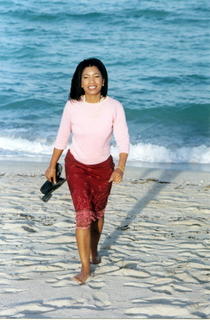
1. Network with old friends and co-workers. Beyond friendship, good will & mental health, friends and former peers can be a very valuable source of contacts, tips and services.
Other former co-workers have passed on story assignments, names of editors, agents, etc.
One former co-worker provided me with coaching and excellent life-lessons about the media industry during the early stages of my career. And through the friend-of-a-friend network, I have landed major career breakthroughs. Thank You! Thank You!
2. Express Gratitude: I've blundered. Melanie's photos have appeared on my blogs for two years and I have failed to give photo credit. (Sorry!) I am now fixing all of my blogs with a credit line for her excellent photographs. I will also make sure she gets a photo credit on my book.
3. Return the favor: I've tried to refer work to those who have helped me in the past. It's good karma and it's a smart business decision. It really takes a village to raise a child, to start a business and to just live.
4. Be mindful of time. When working with friends, it's important to be respectful of their time. Don't take them for granted. Also be flexible. Due to our crazy schedules and the distance between our respective cities, (a 45-minute distance), arranging a shoot required patience, flexibility and resourcefulness. We both had schedule conflicts that required adjustments.
5. Respect your friend's judgment: When hiring a friend, respect their professional opinion. My smile is crooked; my nose is shiny and my left eye (already smaller of the two) often closes when I smile for pictures. That's what I learned while posing. I listened to Melanie's instructions about fixing cosmetic flaws. So even though I felt like a little kid, I sat on a pillow, tilted my head and posed as she ordered.
Bottom line: I listened because I respected and trusted her judgment. Don't hire friends or former co-workers if you don't respect their skills or value their opinions.
6. Be clear about the assignment: Melanie asked me to clearly state how the photos would be used and exactly what I needed. This process saved us from wasting time and money. We also were clear about deadlines and other expectations.
7. Simplify and use natural light: The best photographs Melanie shot involved natural light on the beach and in my home. I learned that I look best in natural light, which is kinder to my 49-year-old face.
The lesson: in seeking financial, organizational and professional solutions to challenges and goals, I should really seek out solutions that work best with the natural lights of my personality and home.
For example, after reading one self-help organizational book, I made myself crazy trying to follow a complicated system for color-coding files and indexing dates. I became even more scattered because I was trying to organize my money, home and work assignments around a system that was way too complex for me.
I now organize my time and life with a very simple computer-based system and manual files. It works for me because it works for me.
8. Follow-up with praise. Provide feedback and praise for those that have provided excellent services. I often thank other professionals that I meet, but I sometimes forget to thank friends, family and peers who have been so helpful and important. Belated and heart-felt thanks to those who have helped to school me and groom me.
9. Work out payment arrangements with friends. No one can live on good will alone. Friends are often shy about asking for payment. Make a point to pay or provide some other compensation for their time. Be specific about contract arrangements. Take nothing for granted, especially not friends.
10. Take time for lunch: It's important to nurture and feed relationships with friends and former-colleagues. Not only is it good karma, but it's smart.
Here are a few helpful articles:
1. how to hire friends
2. How to Hire a Photographer for an Engagement Party
3. Best Friends and business
Weekly Link Love: Favorite Posts
The Mommy Wars, closet battles, and a smackdown with debt are just a few of the posts that I really enjoyed this week. Here are a few of my favorite posts:
From Becoming and Staying Debt Free: Do ya ever have any fun? Great piece about frugal values, credit cards and delayed gratification.
From Millionaire Mommy Next Door: Debt Reduction Tips From A Debt-Free Mommy. She's my new role model. A wonderful how-to about saving money with great links.
From Lazy Man and Money: Weekend Link - Dipping My Toe into the Job Pool Again Edition LazyMan is sooo over the starving artist routine and wants his six-figure salary back! Great post with a great round-up about jobs, professions and money. I also miss the large salary that I enjoyed as a staff writer for a small biz publication.
From Chief Family Officer:Not everyone is meant to be a stay-at-home parent. This is a fabulous post about the ongoing battles between the stay-at-home parents vs the work-away-from home parents. (Translation: The Mommy Wars.) The post includes great comments from others and wonderful links.
From Well-Heeled And Everything: A well-edited wardrobe: This writer provides an excellent how-to about purging, sorting and donating garments from the closet. I'm using this map for cleaning out my own closet.
From The Simple Dollar: Simple Frugality By The Hourly Rate In this post, Trent --as always -- does an excellent job of breaking down the issues of frugality, personal values and the importance of the process. I adore The Simple Dollar.
______________
Digg!
The Frugal Duchess Booktique
The Frugal Duchess of Beauty Store
Book Shop of Fear
The Poetry & Drama Queen
Frugal Jazz & Blues
Frugal Comic Book Connection
__
From Becoming and Staying Debt Free: Do ya ever have any fun? Great piece about frugal values, credit cards and delayed gratification.
From Millionaire Mommy Next Door: Debt Reduction Tips From A Debt-Free Mommy. She's my new role model. A wonderful how-to about saving money with great links.
From Lazy Man and Money: Weekend Link - Dipping My Toe into the Job Pool Again Edition LazyMan is sooo over the starving artist routine and wants his six-figure salary back! Great post with a great round-up about jobs, professions and money. I also miss the large salary that I enjoyed as a staff writer for a small biz publication.
From Chief Family Officer:Not everyone is meant to be a stay-at-home parent. This is a fabulous post about the ongoing battles between the stay-at-home parents vs the work-away-from home parents. (Translation: The Mommy Wars.) The post includes great comments from others and wonderful links.
From Well-Heeled And Everything: A well-edited wardrobe: This writer provides an excellent how-to about purging, sorting and donating garments from the closet. I'm using this map for cleaning out my own closet.
From The Simple Dollar: Simple Frugality By The Hourly Rate In this post, Trent --as always -- does an excellent job of breaking down the issues of frugality, personal values and the importance of the process. I adore The Simple Dollar.
______________
Digg!
The Frugal Duchess Booktique
The Frugal Duchess of Beauty Store
Book Shop of Fear
The Poetry & Drama Queen
Frugal Jazz & Blues
Frugal Comic Book Connection
__
Saturday, December 01, 2007
Save or Pay Down Debt? Tips from Kiplinger's
This guest post about savings vs. paying down debt came to me from the folks at Kiplinger's:
______________
The Frugal Duchess Booktique
The Frugal Duchess of Beauty Store
Book Shop of Fear
The Poetry & Drama Queen
Frugal Jazz & Blues
Frugal Comic Book Connection
__
"Should I save or pay off debt? Borrow from my 401(k)? What if I don’t have extra money to invest?
Here’s what the experts in the December issue of Kiplinger’s Personal Finance magazine have to say:
Should I save or pay off debt?Do a little of both. Invest enough in your 401(k) plan to capture any employer match. That will give you a return of 50% to 100% plus the security of a savings stash. Next, pay off high-interest credit-card balances, which can give you a double-digit return.
Then focus on whatever debt keeps you up at night.
Is it a good idea to borrow from my 401(k)?Nope, not even to pay off debt. If you leave—or lose—your job, you generally have to repay the loan immediately or pay taxes on the money plus a 10% penalty if you’re under age 55. Even if you don’t take a tax hit, you’ll lose the compounded earnings your money would have accrued.
What if I don’t have extra money to invest?Sure, you do. Here are three ways to come up with the cash:
1. Get your employer to help. You won’t miss money that comes off the top of your salary, and a company retirement match is free money. Or arrange to have part of your paycheck deposited into a savings or investment account.2. Invest automatically. A number of mutual fund companies let you get around high minimums if you agree to make regular monthly investments.
3. Find extra cash. Put investable cash in your pocket by filing a new W-4 form with your employer to adjust the number of allowances you’re claiming. Another source of f ready cash: Raise the deductibles on your homeowners and car insurance, which can cut your premiums by hundreds of dollars a year."
______________
The Frugal Duchess Booktique
The Frugal Duchess of Beauty Store
Book Shop of Fear
The Poetry & Drama Queen
Frugal Jazz & Blues
Frugal Comic Book Connection
__
Subscribe to:
Posts (Atom)